Tensegrity Within the Spine: Why Back Pain Is Not Random
The realization that the body never does anything without purpose. Even back pain is not random.
Nothing is accidental. Nothing is without direction.
This concept sits at the foundation of chiropractic science through the first three Universal Principles:
Principle 1 – The Major Premise
A universal principle of organization is continually supplying properties and action to all energy/matter.
Principle 2 – The Chiropractic Meaning of Existence
Existence is the expression of that organizing principle through energy/matter.
Principle 3 – The Union of Organization and Matter
Existence is the union of organizing intelligence and matter.
These principles form the foundation for understanding the spine not as a mechanical stack of bones, but as a living system that distributes tension and motion throughout the body.
Your Body Is Organized by Intelligence
Universal Intelligence is often misunderstood as mystical. In chiropractic science, it is functional and observable through organization and coordination.
According to Principles 8–10, the role of intelligence is to organize information/force and unite it with energy/matter through motion. In the living body, this organization expresses itself through:
-
Coordinated neurological responses
-
Predictable movement and posture patterns
-
Regulation of muscular and connective tissue tone
-
Continuous adaptation across time (Principle 6 – Time)
Because of this organization, what happens within the spine is not coincidence.
It is coordination.
The Spine as a Tensegrity System
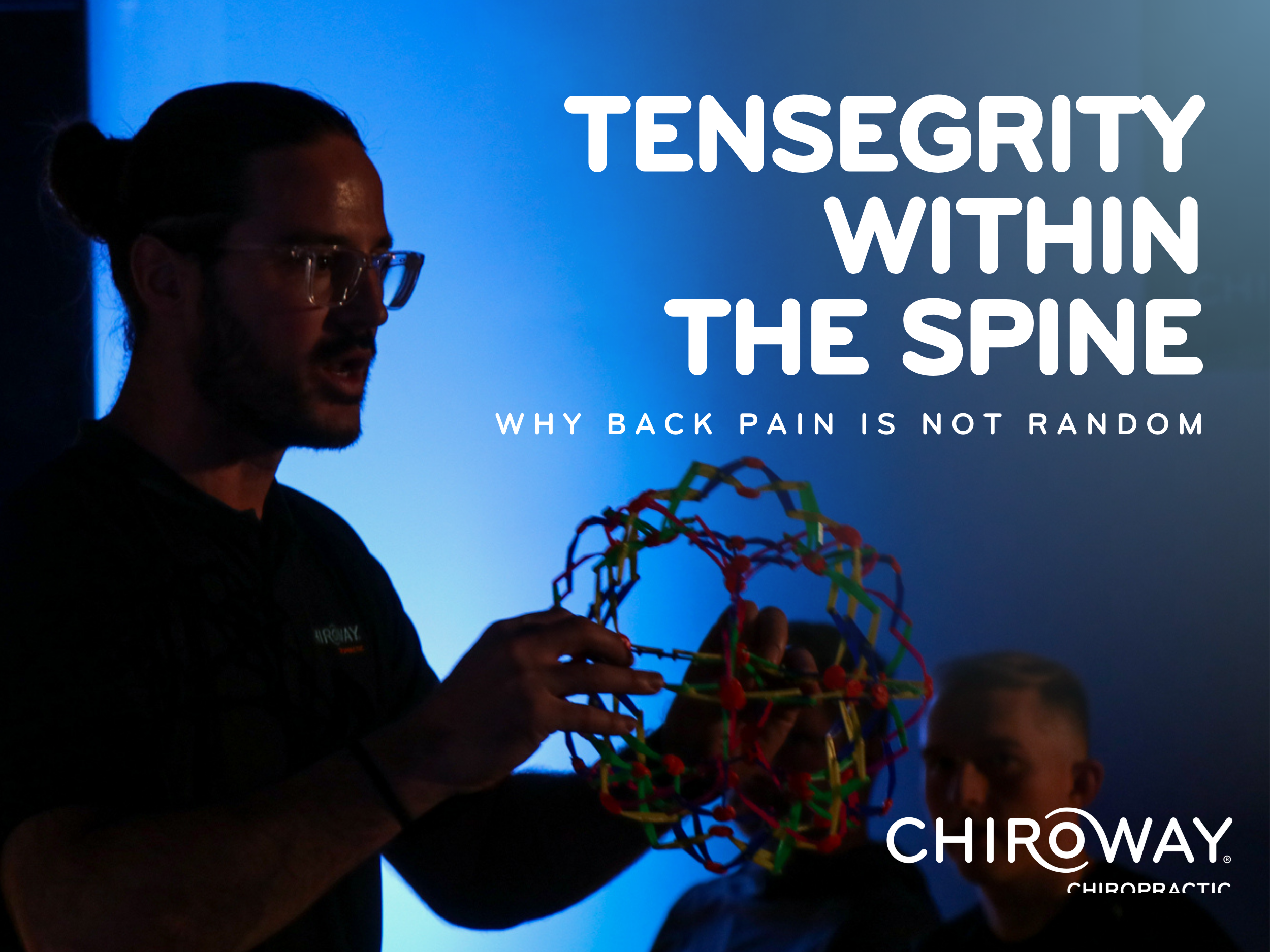
Modern biomechanics increasingly describes the body using the concept of tensegrity. A tensegrity structure maintains stability through balanced tension and compression distributed across the entire system rather than isolated structural support.
The spine functions in this same way.
Instead of behaving like a rigid column stacked under compression, the spine operates as a dynamic tensegrity network where tension distributes across muscles, ligaments, fascia, and neurological control systems.
This reflects Principle 4 – The Triune of Existence, where information, force, and matter intersect.
In the spine, this intersection produces tone, the balanced tension state of tissues governed by the neurological system.
Every experience affects this tone:
-
Posture
-
Breathing
-
Movement
-
Thought
-
Environmental stress
These influences shape spinal tension patterns lawfully, not randomly.
Innate Intelligence and Adaptation
Within living systems, Innate Intelligence governs adaptation (Principles 20–23).
The neurological system continuously evaluates physical, emotional, mental, and environmental inputs and asks a single question:
Can this be adapted according to universal law?
(Principle 24)
When adaptation is possible:
-
Tone remains elastic and coordinated
When adaptation is exceeded:
-
Compensation develops
The spine becomes the record-keeper of this process, storing patterns of adaptation and compensation through changes in tension.
Why Back Pain Is Not Random
Here is the critical advance: Back or neck pain does not mark the origin of dysfunction.
Pain marks the point where intelligent tension distribution has reached its limit.
In a coordinated tensegrity system:
-
Stress is shared
-
Deformation is global
-
Recovery is efficient
When coordination narrows (Principle 32):
-
Load localizes
-
Tone shifts from adaptive to protective
Pain appears not because intelligence failed — but because it changed strategy.
This is consistent with Principle 17 (Cause and Effect):
The cause precedes the effect.
Pain is an effect — not the cause.
Neurological Tone and Interference
The neurological system conducts Innate information/force through the spine (Principle 28).
That conduction depends on an optimal state of tone.
When tension becomes excessive or deficient:
-
Information transmission is altered (Principle 29)
-
Coordination decreases
-
Dis-ease emerges (Principle 30)
This state is what chiropractic identifies as vertebral subluxation.
A vertebral subluxation is not a bone “out of place,” but a loss of coordinated tone and communication within the spinal tensegrity system (Principle 31).
Pain signals that coordination has narrowed — not that intelligence has stopped.
Where Chiropractic Care Fits
The chiropractic objective is precise and exclusive:
To locate, analyze, and facilitate the correction of vertebral subluxation so the conducted Innate information/force may be expressed normally (Principles 31–33).
Chiropractic adjustments do not treat pain directly. They restore conditions for coordination.
By reintroducing motion into restricted fulcrum points and normalizing tone gradients, chiropractic care allows Innate Intelligence to resume efficient load distribution throughout the spinal tensegrity system.
When coordination expands:
-
Energy increases
-
Movement and breathing become easier
-
Tension balances
Pain no longer serves a protective purpose.
Tensegrity Foundations
In earlier writings, we explored spinal function through biomechanics, tensegrity, form-to-function relationships, and neurological integrity, establishing that tension — not structure alone — governs spinal function.
This article extends that foundation by applying those principles to pain itself.
Pain is not random, mechanical, or accidental.
It is a lawful expression of intelligence responding to limits of adaptation.
Rather than redefining tensegrity, this perspective reveals its clinical relevance:
Pain appears where coordination ends.
Your Takeaway
Your body is not guessing. It is responding, intelligently, to every experience you have lived.
If you want your spine to express greater coherence, clarity, and adaptability, support the intelligence that organizes it.
Your next ChiroWay session reveals how your system is organizing right now and how chiropractic care can help restore its full expression.
Schedule your first visit at a ChiroWay Center near you, or share this with someone who could benefit from greater coordination and adaptability.
Lessard, Claude. The Recontextualized Principles of Chiropractic: Chiropractic’s Basic Science. Recontextualized from the original 33 Principles of Chiropractic, as presented in The 2027 Chiropractic Textbook, Volumes 1–2.